

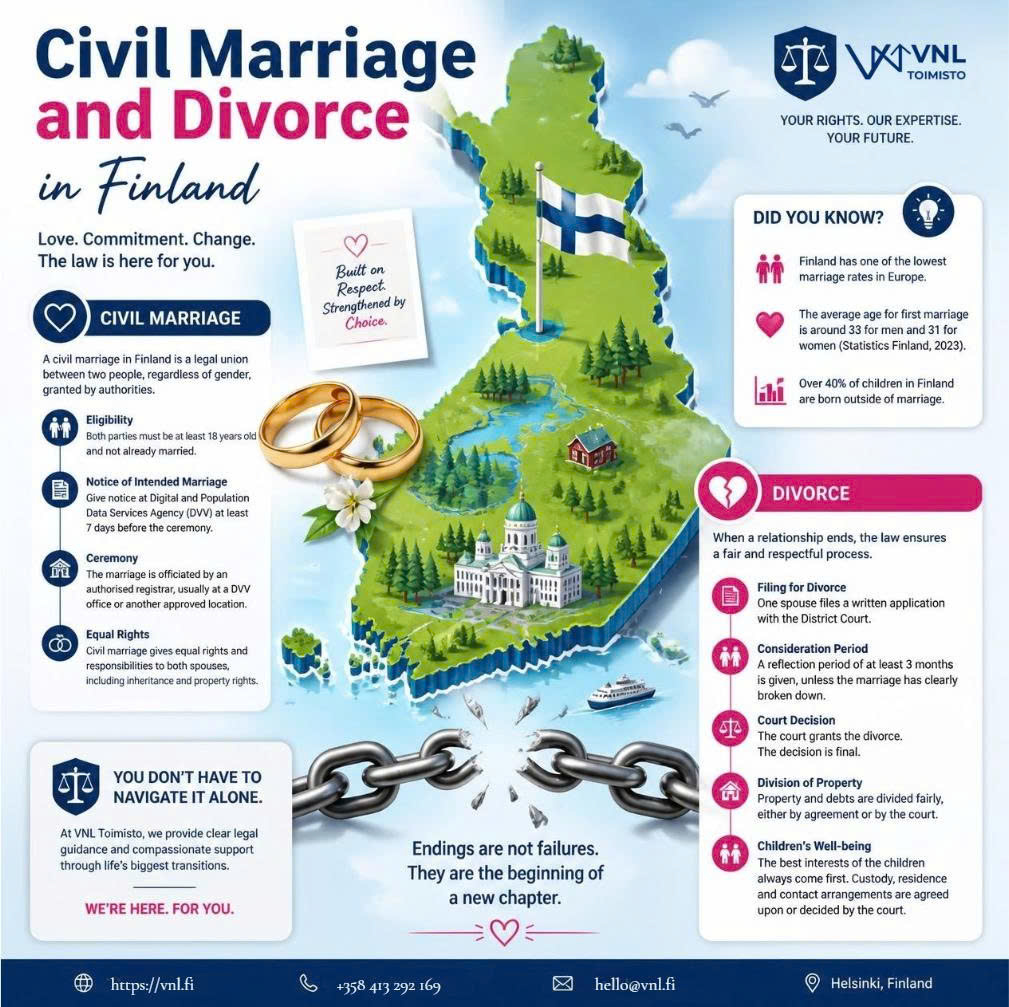
Image for illustrative purposes only
Legally reviewed and advised by Melkko Nguyen (Nguyen Thi Kim Yen) — Founder of VNL Toimisto, Member of the Vietnam Bar Federation, specializing in cross-border legal consulting, document verification, and administrative proceedings between Finland and Vietnam.
Family law in Finland regulates the lifecycle of marital unions through standardized legal frameworks administered by state authorities. Whether entering a civil marriage (siviiliavioliitto) or navigating the dissolution of a relationship through divorce (avioero), understanding the statutory requirements under the Finnish Marriage Act (Avioliittolaki 234/1929) is essential for safeguarding individual rights, property interests, and parental responsibilities.
For expatriates and international couples residing in Finland, family law proceedings involve specific jurisdictional rules, mandatory consideration periods (harkinta-aika), equitable property divisions (ositussopimus), and judicial determinations regarding child custody (huoltajuus).
VNL Toimisto delivers expert legal advisory and administrative representation for civil marriage registration, prenuptial structuring, and divorce proceedings in Finland, protecting cross-border clients through every stage of family transitions.
📞 Need Legal Guidance on Marriage or Divorce Proceedings? Contact our Helsinki office at +358 413 292 169 or reach our legal team via Zalo / WhatsApp.
Core Legal Frameworks: Marriage vs. Divorce
The legal mechanisms governing family formation and dissolution in Finland are structured around clear statutory timelines and protections:
1. Civil Marriage Registration Procedures (Siviiliavioliitto)
Civil marriages in Finland are legally binding unions formalized by designated public officials rather than religious institutions:
Investigation of Impediments (Esteettömyyden tutkinta): Before a wedding can take place, the couple must apply for an investigation of marriage impediments from the Digital and Population Data Services Agency (DVV). This ensures neither party is already married, underage, or within prohibited close blood relations.
The Wedding Ceremony: Civil marriage ceremonies can be performed free of charge at local DVV service locations or district courts by a certified public notary. The ceremony requires two independent witnesses.
Automatic Population Update: Following the civil ceremony, the marriage is instantly recorded in the Finnish Population Information System (Väestötietojärjestelmä), updating tax classes, surname choices, and social security data.
2. Divorce Stages and the Mandatory Reflection Period (Harkinta-aika)
Dissolving a marriage under the Finnish Marriage Act follows a structured judicial pathway designed to encourage settlement and reflection:
Stage 1 (Application): Either spouse alone or both spouses jointly can file a written application for divorce (avioerohakemus) with the local district court (käräjäoikeus). No grounds or fault (such as infidelity or abandonment) need to be proven.
Stage 2 (Mandatory Reflection Period): Once the application is filed, a six-month reflection period (harkinta-aika) begins automatically. If the couple has minor children living at home, this period is mandatory. If they have lived apart continuously for the past two years, the reflection period can be bypassed.
Stage 3 (Final Decree): After the six-month period expires, either spouse (or both) must submit a secondary request (lopullinen erohakemus) to the district court to obtain the final divorce decree (avioeropäätös). This request must be filed within one year of the reflection period starting, or the initial application lapses.
3. Property Division (Ositus) and Asset Settlement
Upon the dissolution of a marriage, all combined assets and liabilities are subject to legal division:
Marital Right (Avio-oikeus): Unless excluded by a valid prenuptial agreement (avioehtosopimus), both spouses possess an equal right to the net assets of the other. The wealthier spouse must make an equalization payment (tasausmaksu) to ensure both parties leave the marriage with equal net wealth.
Property Division Agreement (Ositussopimus): Spouses typically draft a formal written property division agreement detailing how real estate, housing company shares (asunto-osake), bank accounts, and debts are distributed. The agreement must be signed by both parties and witnessed.
4. Child Custody (Huoltajuus), Residence, and Maintenance
When divorcing parents share minor children, Finnish law prioritizes the child’s best interests:
Joint vs. Sole Custody: Parents typically retain joint custody (yhteishuoltajuus), meaning major decisions regarding healthcare, education, and upbringing are made together. Sole custody can be ordered by a court if joint decision-making is impossible or contrary to the child’s welfare.
Child Maintenance (Elatusapu): The parent with whom the child does not permanently reside is generally required to pay monthly child maintenance, calculated based on the child’s needs and the parent’s financial capacity. Agreements must be ratified by the local social welfare board (lastenvalvoja).
Our 4-Step Legal Representation Workflow
Step 1 — Initial Case Evaluation & Strategy: We analyze your family law situation, reviewing existing marriage certificates, prenuptial agreements, and asset structures.
Step 2 — Filing & Administrative Management: We manage district court divorce applications, coordinate reflection period timelines, or prepare DVV civil marriage filings.
Step 3 — Property Division & Asset Negotiation: We draft comprehensive property division agreements (ositussopimus) to protect your financial interests.
Step 4 — Child Custody & Agreement Ratification: We assist in negotiating child custody, visitation rights, and maintenance agreements, securing official ratification through local authorities.
Frequently Asked Questions (FAQ)
Can a foreign citizen get divorced in Finland?
Yes. Finnish courts have international jurisdiction to handle a divorce if either spouse is a Finnish citizen residing in Finland, or if both spouses habitually reside in Finland, or if the applicant has resided in Finland for at least one year immediately preceding the application.
What happens if my spouse refuses to sign the divorce application?
A divorce can proceed unilaterally. If one spouse refuses to file jointly, the other spouse can file an individual application. The court will serve notice to the reluctant spouse, and the six-month reflection period will commence regardless of their consent.
Does a divorce automatically divide our pension savings?
No. Under Finnish law, statutory employment pensions (työeläke) earned during the marriage are not divided or equalized during a divorce property settlement (ositus). Each spouse retains their individual pension entitlements.
Expert Legal Support for Family Law Matters
Navigate marriage registration or divorce proceedings with structural clarity, professional discretion, and full legal compliance under Finnish law. Contact the advisory team at VNL Toimisto.
Disclaimer: This publication serves informative legal purposes regarding civil marriage, divorce proceedings, property division, and family law under Finnish legislation. It does not replace individualized legal representation. Official court decrees and civil status registrations remain under the sovereign jurisdiction of the Finnish District Courts (Käräjäoikeus) and the Digital and Population Data Services Agency (DVV).